
Hijacking bacterial communication
Bacteria use chemical signalling to exchange information and coordinate behaviors. We develop molecular tools to hijack this communication and study this information flux, a promising way to address microbial resistance.
Bacterial cell-to-cell communication is a fascinating mechanism by which bacterial populations can coordinate the expression of numerous genes, and thereby adapt to environmental changes.
A type of bacterial communication, dubbed quorum sensing, is mediated by signaling molecules called acyl-homoserine lactones, and their concentration can be regulated by lactonases. Our group is investigating the potential of lactonases to alter bacterial communication and affect their metabolic state. In particular, the hydrolysis of environmental signaling molecules by a lactonase can inhibit the production of virulence factors and biofilm. New solutions exploiting these properties are currently being developed by the group, such as anti-virulence plasters and anti-biofouling paints.
Interference in quorum sensing differs from any existing approach because lactonases do not need to contact or enter bacteria, but merely degrade secreted molecules to affect bacterial behavior. For these reasons, it is a promising new approach to deal with resistant, pathogenic strains.
Lactonase Lab: watch a lactonase open the signal, step by step
Potential applications
- Wound dressings
- Antifouling paint
- Fewer antibiotics
Try it. Raise the number of bacteria until the glass lights up. Then add lactonase, with the slider or by clicking the mosaic, and watch the signal fall.
Simulation
- Communication signal
- QS on
- QS off

Recent papers on this topic
-
Enzymatic quorum quenching alters the phyllosphere microbiome and suppresses a bacterial-induced plant disease
Scientific Reports 16(1):25561 (2026)
Read the article: Enzymatic quorum quenching alters the phyllosphere microbiome and suppresses a bacterial-induced plant disease PubMed record: Enzymatic quorum quenching alters the phyllosphere microbiome and suppresses a bacterial-induced plant disease
-
Structure-Based Insights into the Molecular Mechanisms of LuxR-Type Quorum Sensing Receptors
Annual Review of Microbiology 80(1):287-308 (2026)
Read the article: Structure-Based Insights into the Molecular Mechanisms of LuxR-Type Quorum Sensing Receptors PubMed record: Structure-Based Insights into the Molecular Mechanisms of LuxR-Type Quorum Sensing Receptors
-
Key paper
N-acyl homoserine lactone signaling modulates bacterial community associated with human dental plaque
npj Biofilms and Microbiomes 11(1):204 (2025)
Read the article: N-acyl homoserine lactone signaling modulates bacterial community associated with human dental plaque PubMed record: N-acyl homoserine lactone signaling modulates bacterial community associated with human dental plaque
In the news ScienceAlert, news story about: N-acyl homoserine lactone signaling modulates bacterial community associated with human dental plaque Yahoo News, news story about: N-acyl homoserine lactone signaling modulates bacterial community associated with human dental plaque
View at full size: picture for N-acyl homoserine lactone signaling modulates bacterial community associated with human dental plaque Podcast about this paper By NotebookLM – AI
6 min
Read the transcript of the podcast: N-acyl homoserine lactone signaling modulates bacterial community associated with human dental plaque
Host 1: Welcome to today's Deep Dive. So our mission today, well, we are exploring how hacking bacterial communication in your mouth could actually revolutionize medicine.
Host 2: Yeah, it's a pretty wild concept.
Host 1: Right, and our sources for this are a research brief and a study from npj Biofilms and Microbiomes. Okay, let's unpack this, because the text sets up this really great analogy. Like, dental plaque isn't just grime to be scrubbed away. It is actually a complex forest ecosystem.
Host 2: Exactly, a microscopic forest. And it starts with these harmless early settlers.
Host 1: Like pioneer species, right?
Host 2: Yeah.
Host 1: Like Streptococcus.
Host 2: Yeah, Streptococcus. But if things get out of balance, that forest basically gets overrun by these dangerous late colonizers. It's a group of disease-causing bacteria they call the red complex.
Host 1: Which sounds incredibly ominous. But how do these microscopic settlers coordinate an entire ecosystem? Because, I mean, they are constantly talking to each other.
Host 2: Right, they have to. Just like in any real forest, they need to communicate to survive and thrive.
Host 1: So I was picturing this like a bacterial group chat. You have, what, like 700 different species of oral bacteria living there, and they are constantly sending each other these chemical text messages.
Host 2: That is a great way to put it. And those chemical texts are called AHLs, or N-acyl homoserine lactones.
Host 1: Okay, AHLs.
Host 2: Yeah. And what's fascinating here is this whole mechanism is called quorum sensing. It's how bacteria organize themselves on a mass scale.
Host 1: So they just release these AHL molecules into their environment.
Host 2: Exactly. They send out the signals, and when enough bacteria do this, the concentration hits a tipping point, a quorum.
Host 1: Oh wow, so they basically take a roll call.
Host 2: Yeah, and hitting that quorum physically triggers receptors in the bacteria. It essentially tells the community, you know, we have the numbers, let's change our behavior. Let's build a biofilm fortress or, you know, go on the attack.
Host 1: But this group chat doesn't work the exact same way everywhere, which is where I admit I got a bit hung up. Because of one crucial environmental factor: oxygen.
Host 2: Right, oxygen changes everything here.
Host 1: So if the bacteria living deep down in those oxygen-deprived anaerobic zones below your gum line don't even produce these AHL messages, why do the texts even matter to them?
Host 2: Well, if we connect this to the bigger picture, you really have to look at the physical landscape of the tooth.
Host 1: Okay.
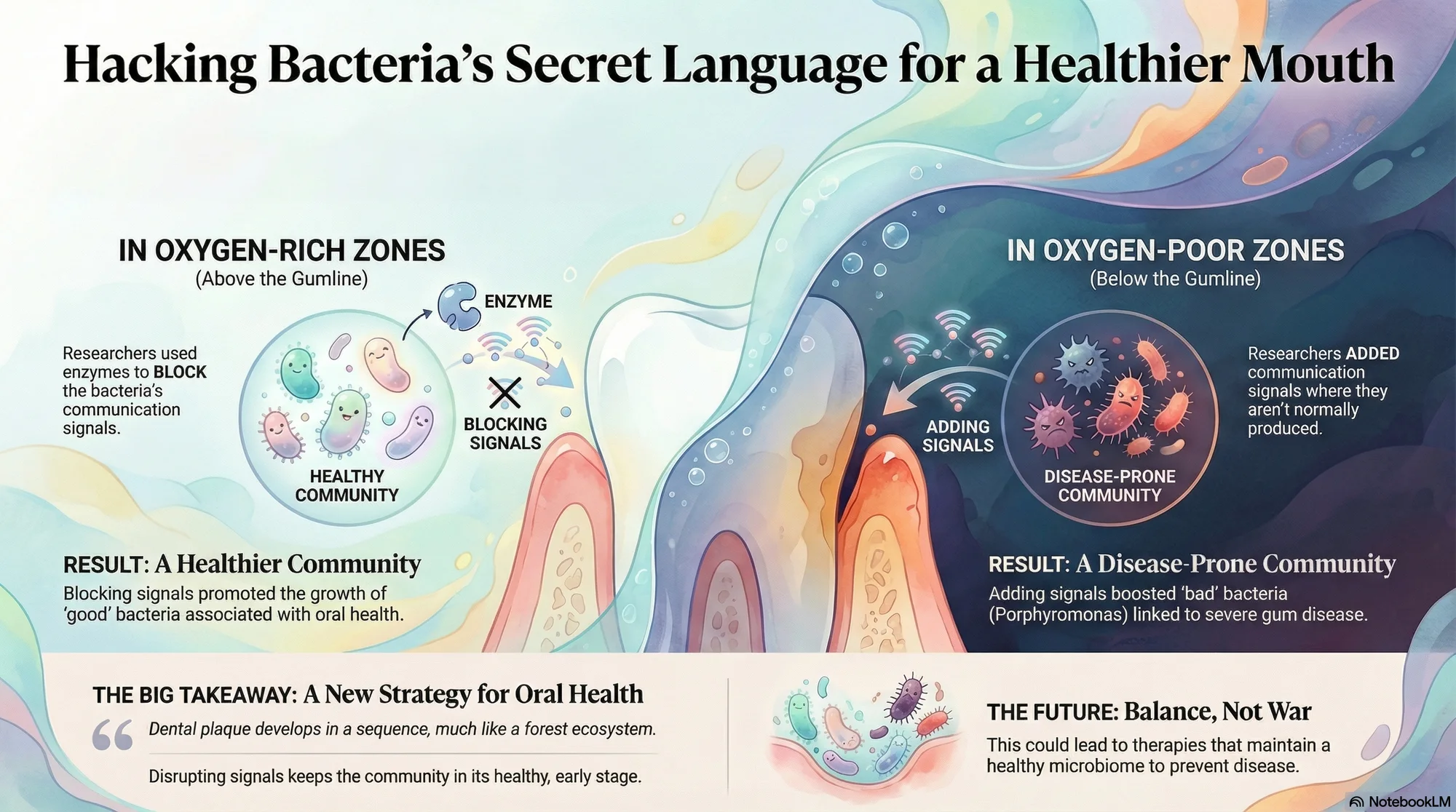
Host 2: So above the gum line, in the aerobic zones, there's plenty of oxygen, right? The bacteria there actively produce these AHL signals.
Host 1: Right.
Host 2: But those chemical signals don't just stay put. They diffuse downward into those deep oxygen-deprived pockets below the gum line.
Host 1: Wait, so the anaerobic bacteria are basically reading messages sent by the aerobic bacteria?
Host 2: Yes, exactly. And the researchers actually proved this in the lab. When they artificially added AHLs to those oxygen-deprived zones, it actively promoted the disease-causing late colonizers.
Host 1: Like Porphyromonas gingivalis.
Host 2: Right. The bad actors were receiving the signal to just take over the ecosystem.
Host 1: Okay, so if receiving these messages triggers a hostile bacterial takeover, it sounds like our best defense isn't actually killing the bacteria, but just, I don't know, jamming their cell service, deleting the texts.
Host 2: Well, this raises an important question. And it's exactly the strategy the researchers tested. They used a process called quorum quenching.
Host 1: Quorum quenching?
Host 2: Yeah, by deploying these specialized enzymes called lactonases. Specifically, they used ones called SsoPox and GcL.
Host 1: Okay, and these enzymes, they destroy the AHL signals.
Host 2: Right, before the bacteria can even read them. They act like chemical scissors. They literally snip the AHL molecules in half, so they no longer fit into the bacterial receptors.
Host 1: Here is where it gets really interesting. Because you would think messing with their communication would just cause random chaos, but deleting these messages actually enriched the good, health-associated bacteria.
Host 2: Yep. The harmless pioneer species just thrived.
Host 1: And furthermore, using different lactonase enzymes physically changed how the bacterial community metabolized sugars and resources.
Host 2: Exactly. When you cut that specific communication line, the bacteria just never received the genetic instructions required to turn on their sugar-fermenting, biofilm-building machinery.
Host 1: So different enzymes act like custom filters?
Host 2: Right. By deploying different lactonases, you filter out different messages, which fundamentally changes their behavior. It reverts the ecosystem back to a healthy state without having to just eradicate everything in sight.
Host 1: So what does this all mean for you listening? It means the future of healthcare isn't about waging a nuclear war on your microbiome with antibiotics.
Host 2: No, it's a complete paradigm shift. Instead of destroying the entire forest, we are just managing the chatter to keep the dangerous predators at bay.
Host 1: Right, strategically cutting communication lines. And the sources note this could eventually be used to treat microbiome dysbiosis throughout the entire body, and maybe even target dysbiosis linked to certain types of cancer.
Host 2: The potential applications are honestly staggering.
Host 1: Absolutely. Well, before we go, I want to leave you with one final provocative thought to explore on your own. If bacteria use these specific chemical dialects to coordinate and build complex, impenetrable biofilm fortresses on our teeth, could human engineers one day use synthetic bacterial chatter to grow living, self-repairing building materials for our physical cities?
Host 2: Oh wow. Like a concrete skyscraper that heals its own cracks.
Host 1: Exactly. All because it's running on a microscopic group chat. Just something to chew on.
-
Durable formulations of quorum quenching enzymes
Scientific Reports 15(1):27435 (2025)
Read the article: Durable formulations of quorum quenching enzymes PubMed record: Durable formulations of quorum quenching enzymes
-
Impeding Quorum Sensing Among the Intestinal Microbiota Impacts the Metastatic Rate of Colorectal Cancer
Cancer Medicine 14(12):e71009 (2025)
Read the article: Impeding Quorum Sensing Among the Intestinal Microbiota Impacts the Metastatic Rate of Colorectal Cancer PubMed record: Impeding Quorum Sensing Among the Intestinal Microbiota Impacts the Metastatic Rate of Colorectal Cancer